Fingerloop Braiding for Beginners
Fingerloop braiding was used in the late medieval period to produce lacing, hose ties, purse strings, seal tags and similar items. It’s also easy to learn, faintly addictive, and adds to your re-enactor cred.

Fingerloop braiding was used in the late medieval period to produce lacing, hose ties, purse strings, seal tags and similar items. It’s also easy to learn, faintly addictive, and adds to your re-enactor cred.

Fish is delish, and it’s totally period. Salt it, smoke it, fry it, poach it, bake it, make it into a mix for invalids, put it in a coffin (pie).
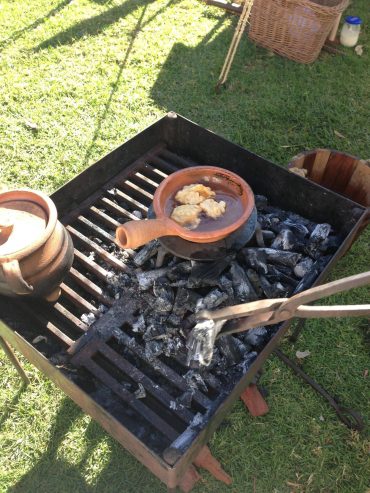
We predominately use ceramic cooking pots now, except when the size of the event that we’re cooking for absolutely precludes it. (And even then we still use them, we just use bigger iron pots for the main dishes.)
So some helpful tips that we’ve picked up

5 simple knots that are very helpful for medieval camping

You’ve probably attended a couple of feasts by now and you’re saying to yourself, “This looks awesome, I really want to run one.” before you commit yourself, I have some advice for you…

So for this last event (Rowany Festival 2017), I entered a contest about making food from scratch. While one of the things I attempted to make (Lamb pate from Menagier de Paris) was an out and out failure, (“It’s not awful, just not edible”) my attempt to make Mustard from the same source turned out rather well.

When food is cooked on site, and it’s no longer cheese and bread but soups and sauces, a wash up is required. It’s a lot easier to wash up if people aren’t being sent back behind the tents like naughty children, but are instead able to be part of the display, showing a very normal, every day task. Here’s how we learned to include washing the dishes in our display.

Company of the Staple is a living history group in Sydney, Australia for living history portrayals of life in Calais, 1376